Showing posts with label chemistry. Show all posts

Monday, September 1, 2014

DNA Replication in 3D Motion


When trying to get a grasp DNA replication—the copying of DNA prior to cell division—it often helps to see what's going.

The static diagrams accompanied by written narrative of the story in most textbooks are good places to start figuring out DNA replication—but it really helps if you can watch it all unfold in 3-dimensional motion.

I've found a video that really helps you understand the process.

A bit of advice before you watch it:
  1. You ought to read through the DNA replication story in your textbook and look at the diagrams there.  If you watch this cold, it may not help you as much.
  2. The details of how the DNA-replicating enzymes work and what they look like is not the important part of the story.  The important part is just seeing how it all works as a biochemical "machine."
  3. I recommend watching the video more than once.  You'll "get it" better that way, because it goes at a pretty fast clip.
  4. Eating popcorn while watching this movie is totally up to you!


Video source: my-ap.us/1ra0MZ2

Image credit: madprime

Thursday, July 12, 2012

Protein folding game

A&P students should be aware of the basic elements of protein folding:

Your textbook describes how the primary structure (a sequence of amino acids determined by the genetic code) is folded into a twisted and pleated secondary structure, then folded again into a complex tertiary structure.  Sometimes, tertiary proteins are combined to form quaternary proteins.  Sort of like origami, but way more useful. And way tinier.

I'd like to mention a interesting phenomenon related to protein folding and "citizen science" using an online game called Foldit.  


The Foldit game is an online puzzle game in which anybody can try their hand and finding which way a given protein folds most efficiently.  Interestingly, this has proven to yield useful results for biochemists not obtainable by traditional methods.

If you like video games . . . and the idea of actually contributing to scientific knowledge intrigues you . . . why not try your hand at Foldit?

Want to know more?
Online Gamers Achieve First Crowd-Sourced Redesign of Protein
Jessica Marshall & Nature magazine
Scientific American Online January 22, 2012
[Brief article about recent redesign of a protein by online gamers using Foldit. Original paper published in Nature Biotechnology]
my-ap.us/wRK2bV

Foldit Online Protein Puzzle
Scientific American Citizen Science accessed 23 January 2012
[Brief description of the online game Foldit and the goals of the project.]
my-ap.us/zIV75F

Foldit - Solve Puzzles for Science
[Direct link to portal for the game Foldit]
my-ap.us/wfRQPF


Saturday, October 15, 2011

Cells hate calcium!

my-ap.us/p2CIFl
I always tell my students to remember these three things:
Cells hate sodium ions (Na+).
Cells hate calcium ions (Ca++).
Cells love potassium ions (K+).
OK, that's not literally true.  As far as we know, cells are not conscious and therefore do not love or hate anything.  But they sure act like they do!

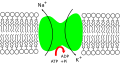
Think about it.  All living cells have Na-K pumps that pump Na+ out while at the same time pump K+ in. When Na+ leaks into the cell, out it goes.  Likewise, when K+ leaks out of a cell, it's pumped back in.

As far as cells are concerned, Na+ is like a rattlesnake and thus is repulsive and must be gotten rid of when it sneaks in.  And K+ is like a puppy that the must be brought in and cuddled.  Should K+ escape to the cold, cruel world outside a cell, it should be brought back inside and cuddled.

Knowing these facts about sodium and potassium ions is useful to A&P students.  Why?  Because it helps explain where these ions are likely to be found in the human body:
  • If you're looking for Na+, look in the solution outside the cell (extracellular fluid). You won't find much Na+ inside the cell, because it is continually pumped out of the cell.

  • If you are looking for K+, don't look in the extracellular fluid. You'll find very little K+ there. Most of the K+ will be inside the cell (intracellular fluid).

my-ap.us/nLkG2W
The fact that there are these sodium and potassium ion concentration gradients help explain the concept of membrane voltage (membrane potential). This idea, then, is the foundation of understanding nerve impulses and muscle stimulation.

During a nerve impulse, Na+ rushes into the nerve cell because of the concentration gradient described above (most of the sodium is outside the cell). This gives the membrane a temporary inside-positive charge… and that's what a nerve impulse is. The normal membrane voltage is restored quickly when K+ is allowed to rush out of the nerve cell, thus moving the net positive charge to the outside of the cell membrane.

All living cells have calcium pumps that pump calcium out of the cell.  Some calcium pumps also pump calcium into sacks (the smooth ER).  To a cell, Ca++ is like a cobra. When it leaks into a cell, and it will, it is pumped out quickly or pushed into a sack.

Knowing this fact about calcium ions is useful for understanding many different concepts in A&P.

For example, muscle fibers pump calcium ions out of the plasma membrane (sarcolemma) and into the sarcoplasmic reticulum (SR, a form of smooth ER). When the muscle membrane is stimulated (see the paragraphs above), the Ca++ comes rushing into the intracellular fluid from the SR and/or from the extracellular fluid. Ca++ immediately binds to the cytoskeleton, which then produces muscle contraction.

A similar thing happens at the end of a neuron when a nerve impulse (see the paragraphs above) gets to its farthest distance and permits Ca++ to flow into the cell. The Ca++ binds to the cytoskeleton and thereby triggers the movement of vesicles filled with neurotransmitter. These vesicles crash into the plasma membrane and release neurotransmitters by exocytosis, thus allowing them to signal another cell.

Ca++ gradients are also key to understanding how many hormones trigger their target cells. It even helps explain some of the functions of sperm cells and egg cells during human reproduction.

So you can see that this idea of cells hating sodium and calcium ions and loving potassium ions comes in pretty handy when trying to understand many of the concepts of human physiology.

Friday, February 20, 2009

Free protein synthesis animations


I was subbing in an A&P class for my friend Mary Ann, and used some animations of transcription and translation.

I nearly got far enough to use some FREE animations available online at Virtual Cell.

The topic of protein synthesis, which includes some processes that I think are best visualized with an animation, has been the subject of many, many, many animated video clips.

A quick search of YouTube reveals several hundred entries for protein synthesis. Other keywords to search YouTube include transcription and translation.

Here are some examples . . .

Here's a good one that I found on YouTube . . .


This is an interesting video that animates the process of protein synthesis using people!


[If you can't see the video players in your email or news feed, then go directly to The A&P Student blog to view the videos.]


Have you found some nice animations on this topic?
If so, share them with us by "commenting" on this article
. . . or email me directly at kevin@theAPprofessor.org