Showing posts with label muscle. Show all posts

Tuesday, October 7, 2014

Humanatomy


Having trouble learning all those facts about the many bones and muscles of the body?

I recently ran across a great set of resources that help you quickly learn the bones and muscles of the body.  A group called Humanatomy, led by teacher Paula Jaspar, has a YouTube channel loaded with short video clips that quickly help you through the parts of the human body's framework.

And they are putting the finishing touches on an iPad game that helps you learn anatomy in a really fun, multisensory way.  You can get the Humanatomy app when it's ready in a few weeks if you contribute to their Kickstarter campaign.

Learning experts tell us that we learn more efficiently (faster and deeper) if you use multiple senses, if you practice in many short spurts, and if you make a game of it.  The Humanatomy approach incorporates all of these ideas in their resources!

To check out their library of FREE videos go to The Humanatomy Channel on YouTube.

To check out their fun app for learning anatomy, go to the Humanatomy Kickstarter page.

You can learn even more by following the Humanatomy blog, where you can also sign up for their free newsletter with learning tips and follow them on Twitter.

Here are a couple of their videos to get you started:

Bones: Elbow Complex


Muscles: Sternocleidomastoid Muscle


Monday, September 15, 2014

Learning Tissues Bird by Bird


What?!  Bird by bird?

Yep—that's the best way to begin learning how to distinguish the various tissue types of the body.

The bird-by-bird approach to learning anatomy is based on two major concepts, described here.


Chunk the List


The first was described by author Anne Lamott in her book Bird by Bird: Some Instructions on Writing and Life:
"Thirty years ago my older brother, who was ten years old at the time, was trying to get a report on birds written that he'd had three months to write. It was due the next day. We were out at our family cabin in Bolinas, and he was at the kitchen table close to tears, surrounded by binder paper and pencils and unopened books on birds, immobilized by the hugeness of the task ahead. Then my father sat down beside him, put his arm around my  brother's shoulder, and said, 'Bird by bird, buddy.  Just take it bird by bird.'"
Wow—doesn't that sound just like the feeling you have when you are given a list of human tissues to learn in your A&P course?  With crazy names like nonkeratinized stratified squamous epithelium, specimens that look like the abstract art exhibit at the art museum, and an insanely short time frame to master them all, of course it feels overwhelming.

Really, that's the best way to tackle the tissues.  Just get started!  And take them one by one, rather than thinking about the whole long list of them facing you.  You'll find that by chunking the list this way, it's not so paralyzing.  It sounds overly simple—perhaps even a bit silly—but it really works!


Focus on Unique Characteristics


A while back, I wrote a post called Trouble with Tissues? in which I briefly described a method for learning tissues based on how birders learn how to tell one bird from another when out birdwatching:

The introduction to my Field Guide to the Body at the Lion Den website compares studying tissues to what birders do when they identify wildlife in the field. Take a look at that brief analogy, including examples of how to apply it to histology, for helpful tips on making this topic easier. If you're using any of my lab manuals in your A&P course, you can apply this technique directly by looking at the Landmark Characteristics boxes scattered throughout the tissue exercises.

To summarize this method, you simply look at what makes each tissue different from other tissues just as you would when learning the many different types of sparrows live in the state park:

  • Field marks—physical characteristics that distinguish one type from another.  All sparrows are LBJs (little brown jobs), but each species has a unique characteristic such as a beak color or streak on the cheek that sets it apart from the others.  Likewise, each tissue type has one or more physical characteristics—such as cell shape or fiber type or cell arrangement—that make it stand out from all other similar tissues.

  • Range—if I look out my window and see a penguin, I know I need my eyes examined.  Because I live in Missouri, where penguins live in only in zoos.  So I can identify birds in part by which birds live in or visit my region.  Bird guides list ranges for this reason—to help you figure out which bird the one in your yard could be.  If you learn the locations of tissues, that helps you figure out where to look for them.  For example, look for most epithelial tissues on surfaces, look for cardiac muscle in the heart.  If you are looking at a tissue sample from the arm, then don't expect that muscle tissue to be cardiac muscle—it's instead likely to be skeletal muscle tissue,

  • Habitat—Besides knowing which region a bird is likely to be found, it also helps to know what kind of habitat it prefers.  Look for forest birds in the forest and look for shore birds, well, along the shore.  With tissues, if you know that if you are looking for irregular fibrous tissue, look under epithelium—there's always some there.

  • Behavior—Behavior is function.  When identifying birds, it helps to know how they fly (do they soar like vultures or hover like hummingbirds?).  When identifying tissues, it helps to know their functions.  If you know that fibrous connective tissues are often supportive in function, that will help you find them.  If you know that smooth muscle tissue compresses the hollow part of hollow organs, you know where to find them—within the walls of hollow organs such as digestive organs.


Not Just for Tissues


This method also works well for learning bones and bone features, muscles of the body, nerves, digestive organs, and more—any of the "birds" of the body!


Want to know more?


Trouble with Tissues?

  • Kevin Patton.  The A&P Student. 28 September 2010.
  • Outlines tips for studying tissues in the A&P course.
  • my-ap.us/14OoEVR

Field Guide to the Human Body

  • Kevin Patton. Lion Den. Accessed 7 September 2014.
  • From my study tips website, this page introduces the "birding" analogy to studying human structures.
  • my-ap.us/1AokMsw

Bird by Bird: Some Instructions on Writing and Life

  • Anne Lamott. Anchor. First published 1 January 1994.
  • Great book.  Great author. That is all.
  • my-ap.us/Yon5jT

Survival Guide for Anatomy & Physiology

  • Kevin Patton. Elsevier. Oct 18, 2013.
  • Tips and techniques for studying A&P, including tissues, mentions the birding analogy.
  • my-ap.us/16aa5zg


Monday, October 15, 2012

Master the trapezius

One of the most recognizable muscles of the human body is also sometimes the hardest to figure out.  I'm talking about the trapezius muscle.   How can it both elevate the shoulder and depress it?  And also produce so many other diverse movements?

The folks at Visible Body have offered a FREE helper to explore the trapezius.  It called the Trapezius Digital Kit and it provides both a downloadable mini eBook and a downloadable video.

Check out the free "digital kit" here:

Also, try out this video:


Saturday, October 15, 2011

Cells hate calcium!

my-ap.us/p2CIFl
I always tell my students to remember these three things:
Cells hate sodium ions (Na+).
Cells hate calcium ions (Ca++).
Cells love potassium ions (K+).
OK, that's not literally true.  As far as we know, cells are not conscious and therefore do not love or hate anything.  But they sure act like they do!

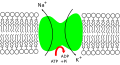
Think about it.  All living cells have Na-K pumps that pump Na+ out while at the same time pump K+ in. When Na+ leaks into the cell, out it goes.  Likewise, when K+ leaks out of a cell, it's pumped back in.

As far as cells are concerned, Na+ is like a rattlesnake and thus is repulsive and must be gotten rid of when it sneaks in.  And K+ is like a puppy that the must be brought in and cuddled.  Should K+ escape to the cold, cruel world outside a cell, it should be brought back inside and cuddled.

Knowing these facts about sodium and potassium ions is useful to A&P students.  Why?  Because it helps explain where these ions are likely to be found in the human body:
  • If you're looking for Na+, look in the solution outside the cell (extracellular fluid). You won't find much Na+ inside the cell, because it is continually pumped out of the cell.

  • If you are looking for K+, don't look in the extracellular fluid. You'll find very little K+ there. Most of the K+ will be inside the cell (intracellular fluid).

my-ap.us/nLkG2W
The fact that there are these sodium and potassium ion concentration gradients help explain the concept of membrane voltage (membrane potential). This idea, then, is the foundation of understanding nerve impulses and muscle stimulation.

During a nerve impulse, Na+ rushes into the nerve cell because of the concentration gradient described above (most of the sodium is outside the cell). This gives the membrane a temporary inside-positive charge… and that's what a nerve impulse is. The normal membrane voltage is restored quickly when K+ is allowed to rush out of the nerve cell, thus moving the net positive charge to the outside of the cell membrane.

All living cells have calcium pumps that pump calcium out of the cell.  Some calcium pumps also pump calcium into sacks (the smooth ER).  To a cell, Ca++ is like a cobra. When it leaks into a cell, and it will, it is pumped out quickly or pushed into a sack.

Knowing this fact about calcium ions is useful for understanding many different concepts in A&P.

For example, muscle fibers pump calcium ions out of the plasma membrane (sarcolemma) and into the sarcoplasmic reticulum (SR, a form of smooth ER). When the muscle membrane is stimulated (see the paragraphs above), the Ca++ comes rushing into the intracellular fluid from the SR and/or from the extracellular fluid. Ca++ immediately binds to the cytoskeleton, which then produces muscle contraction.

A similar thing happens at the end of a neuron when a nerve impulse (see the paragraphs above) gets to its farthest distance and permits Ca++ to flow into the cell. The Ca++ binds to the cytoskeleton and thereby triggers the movement of vesicles filled with neurotransmitter. These vesicles crash into the plasma membrane and release neurotransmitters by exocytosis, thus allowing them to signal another cell.

Ca++ gradients are also key to understanding how many hormones trigger their target cells. It even helps explain some of the functions of sperm cells and egg cells during human reproduction.

So you can see that this idea of cells hating sodium and calcium ions and loving potassium ions comes in pretty handy when trying to understand many of the concepts of human physiology.

Monday, March 22, 2010

Translating muscle names

When you first face that long list of names of muscle that you need to learn in A&P, you may be taken aback by the odd names of the major human muscles.  Well, that and the sheer number of muscles you'll be tested on!

But what makes those muscle names so odd . . . the fact that they are Latin phrases . . . can be used as a shortcut to help you identify those muscles!

For example, the muscle name latissimus dorsi tells you exactly where to find this muscle.  Latissimus means "way over to the side" and dorsi means "back."   So the phrase latissimus dorsi muscle means "back muscle way over to the side."  This not only tells you exactly where the muscle is . . . once you learn the meaning of the name, you have a way to remember the muscle.

Check out this video for a clearer idea of this strategy.

Then check out this article in my Lion Den Study Tips & Tools . . . Muscle Names.

This article also has more video to help you learn the meaning of muscle names AND a FREE downloadable, printable list of muscle names and meanings (and pronunciations).

For a great resource in learning about muscles, perhaps to add to your growing professional library, check out the book The Muscular System Manual: The Skeletal Muscles of the Human Body