Monday, November 26, 2012

Trick to reduce test anxiety

We all get it.  That nervous—sometimes paralyzing—anxiety just before a big exam.  Or worse—we panic and forget even the simplest things during a big test.

Test anxiety.  It’s not just annoying, it can affect your performance.  And your grades!

And final exams are almost upon us.

Recent research has revealed an easy and effective trick for reducing test anxiety during your next big test.  You do this trick just before the test.  I mean in the few minutes you have just before the text begins.  You know, that time you are sitting in the hallway nervously awaiting for the doors to open and the test to begin. Listening to your classmates talk about all that stuff you’re not sure you know well enough.  Frantically going over your notes one last time.  Making yourself a nervous wreck.

OK, so what is this nifty trick?

Journal your anxiety.

What?!  Write out my feelings like in a middle-school diary?

Well, yes—sort of.  Research shows that if you take about ten minutes to write out (not just think about) your feelings at the moment, you’ll feel less anxious during your exam.  And because of that (the research shows) you will do better on the exam! 

On average, students that use this technique raise their grade and average of one whole letter grade.  So even if you think it’s silly, isn’t it worth trying?

Students in a research study reported that by writing out their feelings, they quickly got to a point of calm and confidence.  The writing somehow took the energy out of the anxiety and replaced nervousness with readiness. 

So on exam day.  Get there ten minutes early.  Ignore the raving of your frantic pals.  And just write what’s going through your head.  When the exam starts, you’ll be ready for it.

Want to know more?

Read the story behind this trick:

Testing Anxiety: Researchers Find Solution To Help Students Cope
my-ap.us/TlD6Ba

Check out my advice on breathing to reduce test anxiety:

Don’t forget to breathe!
my-ap.us/dIdsS9

Need some advice on preparing well for exams?

Previous articles on exam strategies
my-ap.us/2CusmI

Brief video on preparing for exams
youtu.be/yrgNyDH3HrQ?hd=1

Another strategy with proven results: 

Tame Test Anxiety: Solid Anxiety Reduction Training
amzn.to/UDScQC


Photo by Josh Davis under CC license

Monday, November 19, 2012

Edraw Mindmap

Making concept maps or "mind maps" is a great way to learn A&P.  It's also a great way to study for your midterm or final exam!

As I've stated frequently in previous posts, a concept map is simply a drawing of a concept.  The simpler the better, so there's no need for artistic skills.

One of my students recently make me aware of another FREE tool you can use to make your own concept maps quickly and easily.  It's called Edraw Mindmap.

If you want to see how it works, check out the Edraw video Make an Effective Mind Map.  This video has a funky robotic narration, but it gives you a quick rundown on how easy the software is to use.  Maybe you should turn off the sound and play your favorite music (the narration simply speaks tips that clearly printed in the video).


Want to know more?

Monday, November 12, 2012

Flow of cerebrospinal fluid (CSF)

Having trouble visualizing the ventricles and canals that contain CSF (cerebrospinal fluid)?   Or the pathway of circulation of the CSF?

Here's a brief animated video that walks you through it all in a simple, straightforward way.

The video uses eponyms and other terminology you may not be using in your course, so here are some translations:
  • ependymal cavity = ventricle
  • foramina of Munro = interventricular foramina
  • aqueduct of Sylvius = cerebral aqueduct (aqueduct of midbrain)
  • foramen of Magendie = median foramen or median aperture (of fourth ventricle)
  • granulations of Pacchioni = arachnoid villi or arachnoid granulations


Click on the image above for a freaky animated MRI (magnetic resonance image) showing the pulsing of the CSF with the hearbeat in aa person with normal pressure hydrocephalus (NPH). Image (c) Nevit Dilmen.

For more on differences in terminology, check out my video: my-ap.us/TmWmiL

Monday, October 15, 2012

Master the trapezius

One of the most recognizable muscles of the human body is also sometimes the hardest to figure out.  I'm talking about the trapezius muscle.   How can it both elevate the shoulder and depress it?  And also produce so many other diverse movements?

The folks at Visible Body have offered a FREE helper to explore the trapezius.  It called the Trapezius Digital Kit and it provides both a downloadable mini eBook and a downloadable video.

Check out the free "digital kit" here:

Also, try out this video:


Monday, October 8, 2012

Blood typing game

typing blood before a transfusion
Here's a nifty little game that helps you practice applying principles of blood typing.  The game has you type the blood of a series of "patients" then figure out which blood units are appropriate to use in a transfusion.

It's pretty simple IF you know the principles of blood typing.

First, review blood typing in your textbook.

Then try your hand at this game:


If you can't see the game in this blog window, go directly to my-ap.us/SYuJXo

Wednesday, September 26, 2012

Skull puzzle

The folks at Visible Body are offering a FREE mini eBook that clearly illustrates and summarizes the 22 bones of the skull. 

This handy little gem will help you get started studying the bones of skull and provide a valuable addition to your set of  study resources.  The three dimensional views of the skull will help give you a deeper understanding of the structure of the skull.

It also gives you an introduction to Visible Body's computer-based anatomy study tools.

Check it out at my-ap.us/UXwSHb

Wednesday, September 12, 2012

Blood viscosity and peripheral resistance

Learning about all the factors that affect blood flow can be daunting.  One of the tough things about it is trying to visualize how all the factors influence blood flow.

One factor affecting blood flow is peripheral resistance.  This is the resistance to blood flow in the peripheral vessels . . . the arterioles.

What kinds of things can cause blood to "resist" flowing as freely as possible?  Well, one factor is the viscosity of blood.  One way to think of viscosity is "thickness" of a fluid.  What makes blood thick?  One factor is how concentrated the red blood cells (RBCs) are in each drop of blood.  Is is often expressed as the PCV (packed cell volume) or hematocrit of blood.  The more blood cells there are in a drop of blood, the thicker--or more viscous--the blood is.  And the more it resists flow.

An analogy we can use to visualize this rather abstract concept is any of the classic TV commercials once used by Heinz to promote their ketchup.  Heinz claimed that their ketchup is better than other brands because it has more tomatoes per bottle of ketchup.  And that, presumably, can be demonstrated by the comparative thickness of their ketchup.  In other words, Heinz ketchup is more viscous than some other brands of ketchup.

As the commmercial below demonstrates, the extra thickness  or viscosity of Heinz ketchup means that it will flow at an incredibly slow rate.


So to summarize this analogy:
  • More tomatoes per bottle of ketchup make the ketchup thicker, or more viscous. The higher the viscosity of ketchup, the more it resists flow and thus the slower it will flow out  the narrow neck of a tipped bottle.
  • Likewise, more RBCs per drop of blood make the blood thicker, or more viscous.  The higher the viscosity of blood, the more it resists flow.  This resistance can be significant where the blood vessels narrow at the peripheral vessels called arterioles.

Wednesday, September 5, 2012

Planes of the body


In a previous post, I addressed that initial struggle with anatomical terminology when beginning a course in anatomy & physiology.  In this post, I'll pick up with another early--but essential--set of concepts: planes of the body.

As with any concept of A&P, one shortcut to understanding is to connect the concept to something simple that you already know about.  Let's see how that could work with anatomical body planes.

For planes of the body, think of them as ways you could slice the body if you had a big giant saw like illusionists use to saw people in half.

If you saw a person so that there is a top part and bottom part of their body, then you’ve cut along a TRANSVERSE or HORIZONTAL plane.  Either term can be used. They both mean the same thing.  It doesn’t have to be equal top and bottom halves . . . ANY separation of top and bottom is a cut along a transverse plane.

If you saw a person into left and right pieces, you are sawing along a SAGITTAL plane.  The word sagittal literally means “relating to an arrow” used in archery.  So imagine shooting an arrow into an apple that is sitting on top of my head . . . and then imagine the apple falling apart into a left and right piece as the arrow slices through it.  That’s a sagittal cut . . . a cut along a sagittal plane.

If the sagittal plane is exactly in the middle, dividing the body along its midline into equal left and right halves, we call that plane a MIDSAGITTAL plane.  If instead the plane is off to one side or another, splitting the body into unequal pieces, it’s simply called a SAGITTAL plan.

If you saw a person into front and back pieces, you are cutting along a FRONTAL plane or CORONAL plane. 

Again, seeing this visually is a good idea. 
  • First, study the images of body planes in your A&P textbook and lab manual. If you are using one of my textbooks or manuals, you can find a handy diagram  of the planes of the body just inside the front or back cover.    By looking at many different diagrams, you'll get a better understanding of the essential concept of body planes . . . as well as plenty of practice.
  • Try constructing a three-dimensional "paper doll" model that resembles the diagram shown here.  Or any kind of simple, hands-on model.  Such activities may seem like a childish project, but it engages many parts of your brain and thus strengthens your learning . . . and your memory.
  • Here's a great YouTube video outlining the concept of body planes:


  • You may find this FREE mini-course to be helpful.  It's called simply Anatomical Directions and it's provided as a free service from Insight Medical Academy. It requires a free registration to use the course, so be sure to register before trying to access the course.  Here's a brief video explaining how the free course works.


Friday, August 31, 2012

Anatomical directions

When starting out in A&P, it's important to get a good grasp of how we talk about directions in the human body.  That's so that we can get down to business and really start describing human structures.  Describing them in a way that is accurate enough to be really clear on where those structures are in the body.

The problem is that most of us feel overwhelmed when a long list of rather foreign terms and concepts seem to suddently fall on top of us and make it hard to breathe!

A good approach is to stay calm and look for ways to connect these ideas to simple concepts that are already familiar to us. Following are some examples to get a good start.

Think of the directions of the body as you would ordinary directions like UP, DOWN, FORWARD, BACKWARD, etc.:

  • Superior UP
  • Inferior DOWN


  • Anterior FORWARD
  • Posterior BACKWARD


  • Lateral TOWARD THE SIDE
  • Medial TOWARD THE MIDDLE


  • Proximal NEAR THE BEGINNING
  • Distal AWAY FROM THE BEGINNING

Notice that the directions above are grouped into opposite pairs.  This is a good way to think of them . . . as pairs of opposites.

Now try the same with these directions:

  • (Anatomical) Left
  • (Anatomical) Right

  • Dorsal
  • Ventral

  • Cortical
  • Medullary

Now look at the diagrams showing anatomical directions in your A&P textbook and lab manual.  If you are using one of my textbooks or manuals , you can find a handy diagram along with a list of direction terms just inside the front or back cover.  My books and manuals also use a an anatomical compass rosette in every illustration, pointing you in the right direction just like the compass rosette found on any ordinary map.

Then try to find similar diagrams by doing an internet image search for "anatomical directions." The more diagrams you look at, the more it will become clear how the directions are used.


Next, try searching for some YouTube videos that explain the anatomical directions of the body.  Here’s a really good one:  


But this is just the beginning.  To truly understand them . . . and to be able to recall them quickly and easily as you must during your A&P course . . . you need to PRACTICE using them.  How you ask?  Aha! I have some strategies that are both fun and effective:

  • Start using them in every conversation.  Explain to your friends or family that the remote is superior to to the television screen but you are about to move it to a position inferior to the screen.  Explain that your pocket is on the lateral side of your jeans.   "Hey look, my shoelaces are dorsal!"  Yes, it's goofy.  But that's part of what makes it effective.  And your friends and family will love helping you study.  Really. The important thing is to do it frequently and throughout  each day . . . until you have reached total mastery.
  • Label your body.  Yep, you read that correctly.  Remember when you were a little kid and you labeled one shoe "left" and one shoe "right" so you could learn your left from your right?  What?! You didn't do that?   Well, if you had then you'd have learned that lesson far more quickly.  Well, here's your chance!  Pin "proximal" and "distal" labels on your sleeve.  Pin a "superior" label on your hat.  Then add an "anterior" label to the front of your hat and a "posterior" label on the back.  Yes, another goofy strategy.  But it's one that works, while also letting others join in the silliness.
    • An extra advantage of this strategy is that when folks see the labels and ask about them, you will be reminded to practice them.  "Oh yeah, I forgot about those labels.  Here, let me explain them to you."  Both the reminder and your explanation of each one will continue to give you the practice you need to master your anatomical directions.
  • Use flash cards to practice anatomical directions.  If you're not already familiar with the many ways to use flash cards to quickly and thoroughly learn anatomical concepts and terminology, check out my many posts describing this method

 In an upcoming post, I'll follow up with some strategies for learning the planes of the body.

Tuesday, July 31, 2012

10 tips for studying the skeleton

One of the first major challenges in learning A&P is learning all the bones and bone features of the human skeleton.  Many students have not had much experience in memorizing physical structures to be identified by sight.

This video from my friend Paul Krieger is a good place to start.  It summarizes some of the basic shortcuts and tips that will help you learn the human skeleton . . . tips that will help you learn any anatomical structures of the human body.


Here are some additional links related to Professor Krieger's "10 tips"

Here's another resource from Professor Krieger that my own students find to be very helpful in learning the human skeleton as well as other concepts of A&P

A Visual Analogy Guide to
Human Anatomy & Physiology

Thursday, July 12, 2012

Protein folding game

A&P students should be aware of the basic elements of protein folding:

Your textbook describes how the primary structure (a sequence of amino acids determined by the genetic code) is folded into a twisted and pleated secondary structure, then folded again into a complex tertiary structure.  Sometimes, tertiary proteins are combined to form quaternary proteins.  Sort of like origami, but way more useful. And way tinier.

I'd like to mention a interesting phenomenon related to protein folding and "citizen science" using an online game called Foldit.  


The Foldit game is an online puzzle game in which anybody can try their hand and finding which way a given protein folds most efficiently.  Interestingly, this has proven to yield useful results for biochemists not obtainable by traditional methods.

If you like video games . . . and the idea of actually contributing to scientific knowledge intrigues you . . . why not try your hand at Foldit?

Want to know more?
Online Gamers Achieve First Crowd-Sourced Redesign of Protein
Jessica Marshall & Nature magazine
Scientific American Online January 22, 2012
[Brief article about recent redesign of a protein by online gamers using Foldit. Original paper published in Nature Biotechnology]
my-ap.us/wRK2bV

Foldit Online Protein Puzzle
Scientific American Citizen Science accessed 23 January 2012
[Brief description of the online game Foldit and the goals of the project.]
my-ap.us/zIV75F

Foldit - Solve Puzzles for Science
[Direct link to portal for the game Foldit]
my-ap.us/wfRQPF


Saturday, June 30, 2012

Homeostasis: life on the wire

A couple of weeks ago, I watched the live broadcast of Nik Wallenda's walk across a high wire suspended above Niagara Falls.  I've been a fan of the famous Wallenda family ever since I saw Karl Wallenda cross a high wire suspended above the baseball stadium in St. Louis. In my A&P classes, we often use the image of a Wallenda on a high wire as a model to help us understand a central concept of physiology . . . homeostasis.

This "Wallenda model" of homeostasis teaches us that to stay alive and well, our body must remain in "balance."  That is, our internal environment is at risk every moment . . . risk of losing the delicate balance of "just right" conditions inside our body that keep us functioning.  If we lose that balance, as Karl Wallenda (Nick's great grandfather) did in the late 1978, then we die.

Like a Wallenda's position on the wire, any physiological variable (any condition in our body that may change) has an ideal range called the set point. The oxygen content of our blood has an ideal range that keeps us healthy, just as the position of a wire walker's center of gravity must remain within a narrow range to stay on the wire (and thus alive).

When a wire walker is affected by wind, rain, distraction--as was Nik during his recent wire walk--this pushes the variable (body position) away from the set point.  If the wire walker reverses the shift by moving left when the body starts to fall to the right, then the set point position is recovered and all is well.  Likewise, when exercise causes a fall in blood oxygen content, the set point can be recovered by an increase in breathing rate . . . thus reversing the fall in blood oxygen content.

Such recovery by sensing a shift away from set point, then responding to the shift by reversing the direction of a disturbance, is called negative feedback.  This is a basic principle of how the body's organs function to keep us alive . . . they continually work to reverse disturbances to the balance of the body.

If you want to learn more about how to use my Wallenda model of homeostasis to understand the balance of the body, check out these resources:

Survival Guide Anatomy & Physiology: Tip, Techniques, and Shortcuts
Kevin Patton
Elsevier Publishing
[Includes a complete rundown of the Wallenda Model of Homeostasis]
my-ap.us/OQ2P3P

Mini Lesson: Homeostasis
Kevin Patton
Lion Den
[Outline summarizing homeostasis.  Includes three different models to help in understanding the balance of the body, including the Wallenda Model.]
my-ap.us/rs3KqV

Wallenda Model
Kevin Patton
Lion Den Slide Collection
[Animated PowerPoint-compatible slide summarizing some points of the Wallenda Model.]
my-ap.us/Mh9ylU
"Life is always on the wire.  The rest is just waiting."
Karl Wallenda
Photo (c) dpape

Tuesday, May 22, 2012

T-charts

T-charts are a simple way to help visually organize concepts when studying anatomy and physiology.  T-charts are a type of graphic organizer or concept map.

Basically, you just take a sheet of paper and draw a huge T on it. Above the crossbar of the T, write a title for your chart.  Then just below the title, create a title on each side of the crossbar.  These are headings for what each area (left and right) below the crossbar will contain.

Then fill in the spaces below the two sides of the crossbar.

 Fill them in with what, you say?  Glad you asked!

The sky is the limit, but here are some ideas (with simple examples). 
  • Put new terms on one side and their definitions on the other.
    • Example: nucleus; central membranous structure of cell containing DNA
    • Example: diffusion; tendency of particles to spread out and reach an equilibrium of concentration
  • Put the names of organs on one side and their functions or descriptions on the other.
    • Example: small intestine; digestion and absorption of nutrients
    • Example: kidney; filtering and balancing of blood plasma, resulting in the formation and excretion of urine
  • Compare/contrast two functions by putting on each side.
    • Example: anaerobic pathway; aerobic pathway
  • Organize structures or functions by area or type.
    • Example: humerus; upper extremity
    • Example: brain; central nervous system
  • List two divisions of a system or organ
    • Example: central nervous system; peripheral nervous system
    • Exampl: sympathetic division; parasympathetic division

Want to know more?

T-chart
[A FREE online tool for fast and easy creation of T-charts.]
my-ap.us/Lzxuko

T-chart graphic organizers
[Blank, printable T-charts in a variety of styles. FREE.]
my-ap.us/Ka1Vtg


Wednesday, March 7, 2012

Say it 18 times

Want to learn your A&P terminology quickly and easily?  In a recent post, I told you that one way to do that is to work on six new words every day.  My friend Jane, the foreign language professor, gave me another tip to help learn new terminology: say each new term out loud at least 18 times.

Apparently, there's evidence suggesting that to "own" a new word, you have to say it out loud at least 18 times.  The vocalization, along with the repetition, apparently help to reinforce memories in the various language areas in your brain.  Which means that you can recall and use the terms easily.

I know that seems silly . . . even childish.  But think about it.  Silly as it may seem, isn't it worth reducing your study time and improving your knowledge quickly?


Want to know more?


Thursday, February 2, 2012

Heart attacks in women

Tomorrow is National Wear Red for Women Day!

In the past, heart disease and heart attack have been predominantly associated with men. Historically, men have been the subjects of the research done to understand heart disease and stroke, which has been the basis for treatment guidelines and programs. This led to an oversimplified, distorted view of heart disease and risk, which has worked to the detriment of women.

Because women have been largely ignored as a specific group, their awareness of their risk of this often-preventable disease has suffered. Only 55 percent of women realize heart disease is their No. 1 killer and less than half know what are considered healthy levels for cardiovascular risk factors like blood pressure and cholesterol. The Go Red For Women movement works to make sure women know they are at risk so they can take action to protect their health.

To help spread awareness at a time that many of you are studying the heart's structure and function, I'm sharing this brief video:


Need help studying the cardiovascular system? 

See previous helps posted in this blog!


[Text source: my-ap.us/AjGQ0u]

New look!

Your favorite blog for A&P students is now sporting a new look!

The new design is easier to read, easier to navigate, and easier to potty train.  It also facilitates sharing on social media (see the icons below each post on the blog).

Have comments on the new design?  Click the COMMENTS link below this post on the blog, OK?  I want to hear from you!

Saturday, January 21, 2012

Six a day

As you begin a new anatomy and physiology course, you will likely feel a bit overwhelmed with the flood of new terminology.  Or a lot overwhelmed with all the new terms.

However, it need not be as big a struggle as you might first think.  There are some tricks and shortcuts . . . and I'm here to let you in on a few of those.

Today's tip comes from my friend Jane, who is a very talented professor of foreign language.  She told me that research as shown that most people can easily learn five to seven new words a day.  That is, if you work at it, you can add about six new words to your vocabulary each day without too much trouble.

That doesn't seem like a lot, but if you spend a few minutes a day you can easily pick up about 45 new terms a week.  That's over 700 new terms in a semester!

But of course, the trick is to put a little bit of effort into every single day.  Simply make yourself six or seven new flash cards, each with a new term, every day.  Review them for  just a few minutes, but do that several times throughout the day.

Don't forget to spend a few minutes reviewing your cards from the days before . . . you don't want to forget those new terms.

If you make this a habit, then you'll find that those few minutes a day can really make a huge difference in your mastery of the terminology of A&P.

Here are some more tips to help you get started learning the terminology of A&P:


There's more! 

Click here to browse my many tips for mastering the terminology of A&P.

Thursday, January 5, 2012

Why be honest?

What if your health professional
cheated their way through school?
As you begin a new semester of anatomy and physiology, the notion of academic integrity is worth thinking about.

What is it? Academic integrity is the honesty with which you participate in your course and other learning activities.

Characteristics of students with academic integrity include:
  • Honestly represent personal work as their own. These students do not copy the work of others and represent it as their own work. 
  • Communicate with the instructor and others truthfully. These students do not make false statements about computer failures, family emergencies, etc., in order to extend deadlines, excuse absences, or gain sympathy.
  • Engage other students with integrity. These students do not enable academic dishonesty by illicitly providing test answers or other academic assignments to other students. They do not "look the other way" when they observe dishonesty, but instead report it to the instructor.
The main reason you want to be honest in your anatomy and physiology course is that you need to learn these concepts. A&P is the foundation of everything else you will encounter in your professional training program and your career. If you use dishonest shortcuts to give the illusion that you have learned more than you actually have, then you will be under-prepared for the rest of the course and the rest of your academic program. It's likely that you won't be able to successfully begin your career.

If you get through your program by cheating, which is not very likely, you may later cause death or illness in a client! How? Because there will be concepts missing from your professional knowledge base.

Now is a great time to develop an ethical, professional mindset. And that mindset MUST include integrity because this is so important for health professionals. You don't want to set yourself up for  failure as a professional and as a person, do you?

Research shows that people who practice dishonesty become more dishonest over time. Yikes. Apparently, it's so easy to get in the habit of cheating that it soon becomes part of who you are and what you always do! Don't let that happen to you . . . it will only cause misery.

A few more reasons students want to practice integrity in the A&P course:
  • They want to avoid the risk being removed their course, removed from their school, or (later) having their degree rescinded when their cheating is discovered.
  • They want their credentials from their course and their college/university to be "worth something" . . . and the credentials won't be worth much if integrity is not the norm.
  • They don't want to be one of the folks listed in the professional newsletters that have been censured, suspended, license revoked, jailed, sued, etc., for offenses that are essentially failures of integrity. Often, the listed offenses are supposedly "one time, this won't hurt anyone, itty-bitty" cheating incidents, as often claimed by the offenders.
  • They don't want their classmates caring for their family and friends (or handling their health records) if their classmates made it through school by cheating, even a little.
  • They want to be prepared fully for the next class, the next program, the next profession. And you cannot be fully prepared if you have pieces missing from your training.
  •  They don't want to be known by their colleagues, friends, and teachers as a cheater.
  • How will they find folks to give them acceptable references if they are known to be dishonest?
When it comes right down to it, you should ask yourself . . . what kind of person do I want to be? You'll sleep better every night for the rest of your life having made the better choice about integrity. This is a big deal when you are older and suffer from insomnia. Just wait.

You may want to review my prior article Why are you here? addressing the importance of learning everything you can in A&P . . . rather than just trying to get through it.


Updated September 2017

Trust image: Lukas Plewnia


Monday, November 14, 2011

How to start concept mapping

Concept maps are a great way to bolster your understanding of human anatomy and physiology.

They're easy . . . concept maps are merely simple sketches that summarize the elements of a concept.  Concept maps can also show how different concepts relate to each other. 

By drawing out a concept, you are arranging ideas in the way that your mind works.  It's how you picture an idea, not how your teacher or your textbook author visualizes that idea.  Therefore, it makes the concept easy for you to understand and remember.

As you construct a concept map, you may run into spots where you're not quite sure how things fit together.  That's great!  This shows you where your "weak spot" is with the concept . . . something you may not have discovered until you faced it in a test.  But when you face it in a concept map, you can stop and figure it out.  You can even take your map to your instructor, your tutor, or your study group and ask for help in figuring it out.  Then you'll "own" the concept and will not likely forget it.

Because it's a picture of a concept, a concept map helps you recall a concept easily.  You'll have the concept stored in your mind as a picture that makes sense to you.  Memory experts tell us that pictures of concepts help us recall those concepts.

If you are primarily a visual learner or kinesthetic learner (or both), then concept maps may become a favorite (and efficient) way of learning A&P!

However, if you've never made a concept map, it may be hard to figure out where to start . . . HOW to start.  So here's a short video that shows you an easy way to get started . . .

Check out this pencast on how to start a concept map.

Saturday, October 15, 2011

Cells hate calcium!

my-ap.us/p2CIFl
I always tell my students to remember these three things:
Cells hate sodium ions (Na+).
Cells hate calcium ions (Ca++).
Cells love potassium ions (K+).
OK, that's not literally true.  As far as we know, cells are not conscious and therefore do not love or hate anything.  But they sure act like they do!

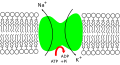
Think about it.  All living cells have Na-K pumps that pump Na+ out while at the same time pump K+ in. When Na+ leaks into the cell, out it goes.  Likewise, when K+ leaks out of a cell, it's pumped back in.

As far as cells are concerned, Na+ is like a rattlesnake and thus is repulsive and must be gotten rid of when it sneaks in.  And K+ is like a puppy that the must be brought in and cuddled.  Should K+ escape to the cold, cruel world outside a cell, it should be brought back inside and cuddled.

Knowing these facts about sodium and potassium ions is useful to A&P students.  Why?  Because it helps explain where these ions are likely to be found in the human body:
  • If you're looking for Na+, look in the solution outside the cell (extracellular fluid). You won't find much Na+ inside the cell, because it is continually pumped out of the cell.

  • If you are looking for K+, don't look in the extracellular fluid. You'll find very little K+ there. Most of the K+ will be inside the cell (intracellular fluid).

my-ap.us/nLkG2W
The fact that there are these sodium and potassium ion concentration gradients help explain the concept of membrane voltage (membrane potential). This idea, then, is the foundation of understanding nerve impulses and muscle stimulation.

During a nerve impulse, Na+ rushes into the nerve cell because of the concentration gradient described above (most of the sodium is outside the cell). This gives the membrane a temporary inside-positive charge… and that's what a nerve impulse is. The normal membrane voltage is restored quickly when K+ is allowed to rush out of the nerve cell, thus moving the net positive charge to the outside of the cell membrane.

All living cells have calcium pumps that pump calcium out of the cell.  Some calcium pumps also pump calcium into sacks (the smooth ER).  To a cell, Ca++ is like a cobra. When it leaks into a cell, and it will, it is pumped out quickly or pushed into a sack.

Knowing this fact about calcium ions is useful for understanding many different concepts in A&P.

For example, muscle fibers pump calcium ions out of the plasma membrane (sarcolemma) and into the sarcoplasmic reticulum (SR, a form of smooth ER). When the muscle membrane is stimulated (see the paragraphs above), the Ca++ comes rushing into the intracellular fluid from the SR and/or from the extracellular fluid. Ca++ immediately binds to the cytoskeleton, which then produces muscle contraction.

A similar thing happens at the end of a neuron when a nerve impulse (see the paragraphs above) gets to its farthest distance and permits Ca++ to flow into the cell. The Ca++ binds to the cytoskeleton and thereby triggers the movement of vesicles filled with neurotransmitter. These vesicles crash into the plasma membrane and release neurotransmitters by exocytosis, thus allowing them to signal another cell.

Ca++ gradients are also key to understanding how many hormones trigger their target cells. It even helps explain some of the functions of sperm cells and egg cells during human reproduction.

So you can see that this idea of cells hating sodium and calcium ions and loving potassium ions comes in pretty handy when trying to understand many of the concepts of human physiology.

Monday, September 19, 2011

Study Droid

Looking for a way to tame the thousands of terms you are flooded with in your A&P course?

Looking for a shortcut to memorizing  structures in your A&P lab?

How about an easy way to practice identifying histology specimens, anatomical structures, and important concepts?

Maybe you've already found out what bazillions of A&P students before you have discovered . . . flash cards!

One of many web-based tools that you can use is Study Droid.

If you want to see one student's take on Study Droid, then check out this video.


If you want a more focused tutorial on how to use Study Droid, then check out this video.


Already using Study Droid to study for A&P, then let's hear about your experience!

Sunday, August 28, 2011

The Bloodmobile


Sometimes catchy little songs can help us learn even very complex concepts.

My friend Ellen recently sent along this video with the snappy tune Bloodmobile.  This song from They Might Be Giants summarizes the main functions of the blood . . . a very timely topic for those of you at the beginning of your A&P 2 course.


While we're on a cardiovascular theme, you may recall seeing my previous post Pump Your Blood that features the classic song of the same name that has been used by countless A&P students to learn the path of blood through the heart.

Have any more?  Why not share them?

The Bloodmobile

Thursday, August 18, 2011

Learn your anatomical directions!


As you begin studying the structure and function of the human body, you'll find that you need to be thoroughly familiar with the terminology used in anatomy to describe directions and orientation.

It may seem overwhelming at first, but it's a necessary step in learning everything else in anatomy.  It's like knowing north from south and east from west when beginning a course in geography.

The Anatomy Coloring BookExtra time and effort spent to learn anatomical directions and orientation at the beginning of the course will make most of the next semester or two . . . and beyond into other courses and your career . . . go way more smoothly.  Really.  It's hard to see that now, I know.  But trust me!

Besides your learning in the lab and lecture course, and working through your textbook and lab manual, you may find this FREE mini-course to be helpful.  It's called simply Anatomical Directions and it's provided as a free service from Insight Medical Academy. It requires a free registration to use the course, so be sure to register before trying to access the course.  Here's a brief video explaining how the free course works.

Thursday, August 11, 2011

Sleeping through A&P


Research confirms it . . . sleeping helps you learn A&P! 

OK, I'm not talking about sleeping during your A&P class.  That kind of sleeping hurts your ability to learn A&P.

Although we've known about this for a long time, recent research in mice adds to the evidence that a session of uninterrupted sleep helps you learn things.  Here's a link to a brief, easy-to-understand explanation of the research: my-ap.us/ne2WaP

What this means is that you should make great effort to get a good night's sleep every day that you study A&P.  That means sleeping well on nights that follow your lectures, labs, and study sessions. Or even better: getting a good night's sleep every night!


Yeah, I know . . . there are all kinds of things that interrupt your sleep.  What I'm saying is that it's important to reduce those interruptions as much as possible.  It may mean that you need to get others in your life "on board" with your learning goals, as I explained in a recent post. It may mean changing your schedule around a bit. 

The Harvard Medical School Guide to a Good Night's Sleep (Harvard Medical School Guides)A lot of folks don't really have good sleep habits . . . at that prevents them from sleeping well.  Which prevents them from learning well.  There are a lot of resources for learning good sleep habits, so if you have trouble sleeping well you should do a bit of research or find some professional help.

Besides helping you learn, good sleep habits also help you stay awake during class . . . no matter how boring your professor is!  Regular, uninterrupted sleep also helps you stay healthy and live a longer, happier life!

My A&P students are always looking for ways to help them remember things.  So here's something that's easy: just make sure you get a good night's sleep!

Here's a short video on good sleep hygiene using tips from the CDC and acted out by students at Miami University.

Thursday, August 4, 2011

The art of listening

I just ran across a short video in which "listening expert' Julian Treasuresummarizes five easy ways to become a better listener. 

He also points out why listening is important and why it's a skill that, as a culture, we are losing.  And perhaps more importantly for our quest for success in our anatomy & physiology course, he mentions why good listening skills are important for students.

I see so many students "out of focus" and "out of tune" with what is happening in the A&P lecture and lab.  So I know that good listening skills are not common in today's students.  This video will help make you a better student!

Mr. Treasure also talks about having the"listening position" appropriate to the kind of listening in which we are engaged.

He sums up with a quick acronym, RASA, that helps us remember some key points in listening effectively:

Receive
Appreciate
Summarize
Ask

Check out the video! (and listen carefully) 
Click image to view video


Friday, May 20, 2011

Not just for A&P!

If you've wrapped up your A&P course, you may think you no longer need advice, tips, and shortcuts from this blog.

But you'd be wrong!

As I mentioned in a previous article (my-ap.us/is1Wa6), this is just the beginning of a lifetime of using A&P!  I suggest staying tuned in to this blog because you can continue to benefit from most, if not all, future articles as you struggle through your professional training and the continuing education that is required of working health professionals.

An easy way to keep up with this blog is by signing up for the FREE email updates using the form at the right of the blog page or at theapstudent.feedblitz.com

And while I have your attention, I'd like to make my usual end-of-semester plea:

Do NOT sell, give away, recycle, or burn your A&P textbook!

Really, I mean it!  You will regret it if you do. You're going to need it as you progress through future studies and into your practice as a health professional.  See my advice at my-ap.us/mhYggB

Sunday, May 15, 2011

Future Health Scholarship

Are you pursuing a career in health care

Could you use an extra $5,000 or $10,000 to help pay for your schooling?

Then you should check this out:


Tylenol 2011 Future Health Scholarship

Wednesday, April 20, 2011

Synapatic Cleft rap video

Need a fresh perspective on the function of nerve signaling?

Here's a parody of Wu-Tang's "Gravel Pit" made by students to help them integrate their knowledge of synaptic signaling and the role of neurotransmitters.

Check out the video (after making sure that your speakers are cranked up):


Download the audio

You may want to review the nerve cell outline before or after watching the video.

Did you know that the discovery of the first neurotransmitter happened in a dream?  Really! Check out Receptors by Richard Restak.

Looking for other silly songs?

Wednesday, April 13, 2011

Use Word Stash for learning new terms

In several previous articles, I mentioned that the first step in learning the concepts of anatomy and physiology successfully is to learn the language.  You need to master the terminology before you can begin to understand the ideas.

And in many of those previous articles, I pointed out that learning new terms--even a huge number of new terms--can be fast and easy if you simply practice, practice, practice.  Every day.  Several times a day.  But just a few minutes at a time.

And an easy way to practice is using flashcards.  Flashcards can be either traditional paper 3"x5" index cards or any of the many computer-based variations of the flashcard technique.

Recently, a reader of this blog recommended another of the web-based varieties of flashcards.  It's called Word Stash it's a great FREE tool that's very easy to use.

Mosby's Anatomy & Physiology Study and Review CardsIt gives you several options to create word lists, using previously used definitions from a database or using definitions that you write or copy from your course materials.

If you tell your A&P professor about Word Stash, they can create a "class" and load in word lists from their course.  Or your study group or tutor can create a "teacher account" and create a list that is shared by anyone who is part of that class.

I created a class called, you guessed it, The A&P Student . . . and loaded in a word list to show you how it works. Join this "class" to see how Word Stash works:

Password: theapstudent

You'll have to register as a user during the process of accessing this class and word list.  Then play around with the different ways to practice the terms!
Practice!
Practice!
Practice!